
Electromagnetic Interference (EMI) is a silent disruptor of the critical electronics that power today’s fighter jets, missile guidance systems, satellites in space, and autonomous vehicles. When unwanted high-frequency high-amplitude EMI reaches the analog front-end, it disrupts the operational amplifiers that read critical sensor data. Through a nonlinear demodulation and rectification, this interference generates an unintended DC offset at the amplifier’s output. This shift can drive the circuit into saturation, leading to a functional failure. In an airborne fighter jet or driverless car, this loss of sensor fidelity can be catastrophic. Conversely, this exact EMI susceptibility can be utilized as a defense to neutralize enemy electronics.
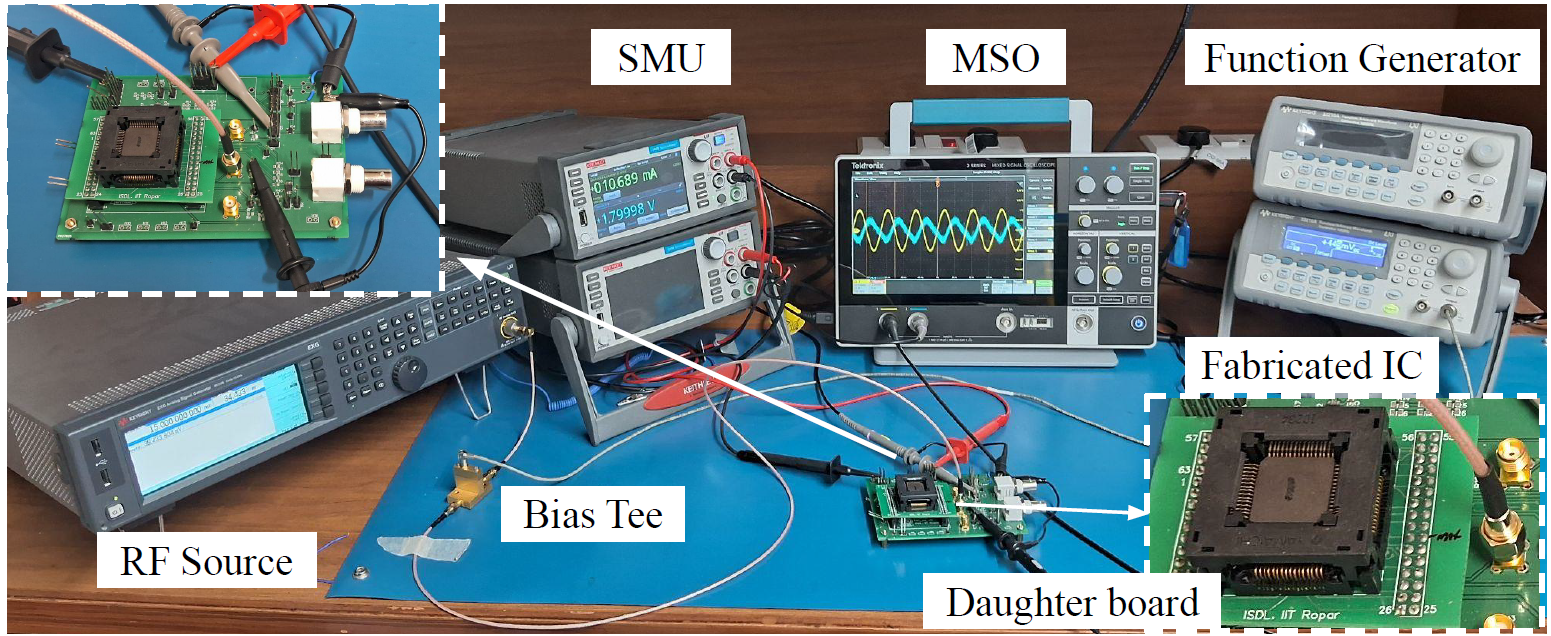
Post-silicon validation: EMI susceptibility measurements of EMI immune operational amplifiers and three-OpAmp instrumentation amplifier. An RF Source is used to inject EMI-mimicking high-frequency high-amplitude interference to the circuits under test.
Our research [1], published in Transactions on Electromagnetic Compatibility, introduces a highly resilient analog interfacing circuit designed to survive heavily polluted electromagnetic environments. The core contribution is the development of a novel EMI-immune Operational Transconductance Amplifier (OTA) and a three-OpAmp Instrumentation Amplifier (INA). We minimized the parasitic capacitance at the source-couple node and adjusted the gate-source capacitance of the differential input pair accordingly. The low-voltage cascode tail current source replaces the conventional one to boost its impedance and avoid asymmetric slew rates, thereby minimizing the offset. The immunity is achieved without introducing any power overhead or increasing overall design complexity. By leveraging the inherently shielded OTA architecture and optimizing it for better matching, the resulting INA is hardened against high-frequency high-amplitude interference. This system-level resilience is achieved without trading the Common-Mode Rejection Ratio (CMRR) or degrading the in-band offset parameters critical to the nominal operation and precision of sensitive analog sensor readouts.
The demand for infallible hardware is more urgent than ever, as our modern environments are becoming exponentially saturated with electromagnetic noise—driven by the rapid deployment of 5G and emerging 6G communication networks, the explosive growth of interconnected IoT devices, and the ubiquitous presence of radar systems. By addressing EMI susceptibility at the foundational circuit level, this research provides a critical safeguard against this growing invisible pollution.
Date of the story: 08 June, 2025
Contributors: Shivdeep, and Devarshi M. Das
Broad Field of Work: Analog IC design | EMI-immune amplifiers | Hardware Security
Faculty: Dr. Devarshi M. Das, Asst. Professor, Department of Electrical Engineering, Indian Institute of Technology Ropar
Funding Agencies: Meity GoI, DoT GoI Grant No.: TTDF/6G/363
Year of Publication: 2026
Reference(s):
- Shivdeep, S. Sharma, M. Sakare and D. M. Das, “Mitigating EMI Susceptibility in Three Opamp INA with a High CMRR EMI Immune OTA,” in IEEE Transactions on Electromagnetic Compatibility, doi: 10.1109/TEMC.2026.3677893.
Group Website (if available): https://devarshi.in/
Keywords:
Electromagnetic Interference
Offset
Instrumentation amplifier
Hardware security
CMOS amplifiers
